
TL;DR
- 18K and 750 mean the same thing: 18 parts gold out of 24, or 750 parts per 1,000, which is 75% pure gold. White, yellow and rose 18K rings all carry the same mark. The stamp tells you purity, not colour.
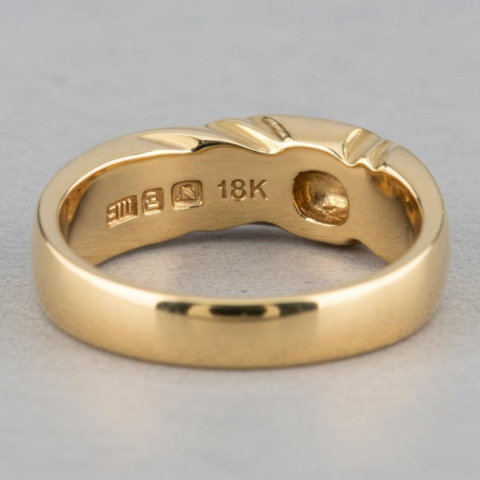
- Look inside the band first. Genuine 18K rings normally carry the purity stamp plus a second mark that identifies who made or tested it (a maker's mark, trademark, assay office mark or, in India, a BIS logo and HUID code).
- Letters after the number change everything. " 18K " alone is solid gold. " 18K GP", "18K GEP", "18K HGE", "RGP" or "GF" mean the gold is only a coating or layer.
- 2026 update in one line: the US still follows the FTC Jewelry Guides last revised in 2018, the UK Hallmarking Act 1973 is still in force while reform is being discussed, and India has widened mandatory BIS hallmarking and raised the hallmarking fee to ₹75 per article. Details and what to do about each are below.
- A stamp is a claim, not proof. Treat it as step one. Step two is a documented test (XRF scan, assay report or a recognized hallmark ).
Why we wrote this guide of 18K gold ring markings
Every week our team handles questions that start the same way: "The ring says 750. Is that real 18K?" or "My ring says 18K but the gold looks thin on the finger. What happened?" We work with 18K gold at the bench, so we are used to turning a ring over under a loupe and reading what is stamped inside it. Most buyers have never been shown how.
This guide is the walkthrough we give people when they ask. It covers what each marking means, what changed in 2026, how we read a ring in five steps, which stamps mean "plated", and what to put in writing if you order a custom ring. If you finish this page, you should not need to open another tab to understand an 18K ring marking.
What "18K gold ring markings" actually include
When people say "markings" they usually mean three different things stamped or laser-marked in the same small area. Mixing them up is the number one source of confusion.
- The purity (fineness) mark. This is the number or karat stamp: 18K, 18KT, 18ct, or 750. It states how much gold is in the alloy.
- The responsibility mark. This is who stands behind that claim: a maker's or sponsor's mark, a registered trademark, an assay office mark, or in India the BIS logo.
- The extra codes. Date letters, serial numbers, country or city symbols, HUID codes, size marks and plating abbreviations.
Karat and fineness are simply two scales for the same fact. The karat scale divides gold into 24 parts. The millesimal scale divides it into 1,000. So:
| What you see | What it means | Gold content |
|---|---|---|
| 18K, 18KT, 18ct | 18 of 24 parts gold | 75% |
| 750 | 750 of 1,000 gold parts | 75% |
| 18K 750 or 18K750 | Both scales on one ring | 75% |
| 14K / 585 | Lower purity, more durable | 58.5% |
| 22K / 916 | Higher purity, softer | 91.6% |
| 24K / 999 | Fine gold, rarely used for rings | 99.9% |
| 9K / 375 | Common in the UK, still legally gold there | 37.5% |
The remaining 25% in an 18K ring is alloy: copper and silver for yellow, more copper for rose, and palladium or nickel for white gold. Because only the gold fraction is marked, an 18K white gold ring and an 18K yellow gold ring are stamped identically.
The 2026 update: what changed and what did not
Because we are asked about "the latest rules" constantly, we checked the official sources again in November 2026. There is no single global rule for 18K ring marking, so what matters depends on where the ring is made, sold or imported.
United States: no new federal rule, but the same rules still bite
The FTC's Guides for the Jewelry, Precious Metals, and Pewter Industries (16 CFR Part 23) were last revised in 2018, and when we checked in November 2026 we found no newer revision. The practical points have not moved:
- Calling an item gold, or stamping a karat quality mark, must reflect real karat fineness.
- Manufacturers are allowed a small tolerance below the marked fineness: 3 parts per thousand for unsoldered items, and 7 parts per thousand where solder is involved. For 18K that means a plain piece should assay at roughly 747 or above, and a soldered assembly at roughly 743 or above.
- When a karat quality mark is applied, federal stamping law expects a registered trademark or maker identification next to it, so there is someone accountable for the claim.
- Gold-plated, gold-filled and similar products need qualified descriptions and, where marked, abbreviations that make the plating obvious.
What we do about it: we put the karat mark and a maker identification on every 18K ring and we never let a plating abbreviation and a plain "18K" sit alone on the same piece.
United Kingdom: the law stands, reform is in motion
Under the Hallmarking Act 1973, gold articles above the exemption weight (1 gram for gold) must carry a hallmark applied by a UK assay office, or a recognized equivalent such as the Common Control Mark for imports from convention countries. A UK hallmark for 18ct gold includes the sponsor's mark, the fineness mark 750 and the assay office mark. The date letter has been optional since 1999.
What changed in 2025 to 2026 is the conversation around the law, not the requirement itself. The four UK assay offices wrote an open letter in December 2025 asking for reform because so much jewelry is now sold through online marketplaces. The government replied in early 2026 and signaled an intent to amend the legislation, and the British Hallmarking Council published the results of an industry consultation in May 2026. As of our check, the 1973 Act and the role of the assay offices remain unchanged. Trading standards guidance also reminds sellers that calling a piece "yellow metal" or "white metal" does not avoid the hallmarking requirement when the item is actually gold.
What this means for you: if you sell or buy 18K rings in the UK, expect closer scrutiny of online listings. Make sure the hallmark is visible in photos and the listing describes the metal exactly as it is hallmarked.
India: wider coverage, stricter checks, higher fees
India is where the markings changed the most. BIS hallmarking is mandatory for gold jewelery in notified districts. Every hallmarked piece carries three elements: the BIS logo, the purity grade (written for 18K as 18K750), and a six-character alphanumeric HUID that can be verified against the BIS database. Reporting in 2026 describes coverage reaching 380 districts after a sixth rollout phase in March 2026, and a September 2026 amendment raising the fee a jeweler pays per gold article from ₹45 to ₹75. BIS rules also provide compensation when the purity is found below what was marked.
What this means for you: an Indian 18K ring without a BIS logo and HUID, bought in a covered district, is a red flag. An old ring from before the rules may legitimately lack them, but it should be tested.
European Union and Switzerland
Much of Europe uses the Vienna Convention Common Control Mark: a balance-scale symbol with the fineness number (750 for 18K) and a responsibility mark. Other countries use national marks. France's eagle's head is the state mark for 18K, and Italian rings usually show 750 with a star, a provincial number and a maker's ID code. None of these were reformed in 2026, but they explain why your ring may show an animal or a star instead of the letters "18K".
Where to find the markings on a ring
In our workshop we mark a ring where it will be seen but not worn away. Most makers do the same, so check these places in order:
- Inside the shank (inner band). The most common location, often at the bottom of the band, opposite the stone.
- Under the head or basket. Solitaires and halo rings sometimes carry the stamp beneath the setting.
- Along the edge or underside of a wide band. Flat or signet-style rings often have it on the inner edge.
- Near the opening of a gallery or hinge. Seen on hinged or complex designs.
- On a separate part. Where a ring mixes metals (for example an 18K band with a platinum head), each part may carry its own mark.
A few reasons a mark may be hard to find:
- Laser marking fine leaves, shallow letters that can look faint at an angle. Turn the ring under a light.
- Stamping wear from years of resizing and polishing can erase marks, especially on thin shanks.
- Very small rings may carry only a micro-mark or the number alone (for example 750).
- Resizing can remove the stamp if a jeweler cuts through that area. A resized ring should be re-marked.
Use a 10x loupe, or the macro mode on a phone with a bright, angled light. If you cannot read the mark, that is a reason to test the ring, not a reason to assume it is fake.
How we read an 18K ring in five steps
This is the process we use. It takes a couple of minutes and catches most problems.
Step 1: Find and photograph every mark. Photograph each stamp up close before you decide anything. Notes made from memory are unreliable.
Step 2: Identify which marking system you are looking at. Karat letters (18K, 18KT) point to US, Canadian or general international marking. Three-digit numbers (750) point to fineness marking. Symbols such as an eagle's head or a star point to a national hallmark. A BIS logo with a six-character code is India.
Step 3: Check that the companion marks make sense. A good 18K ring should have a purity mark and a mark that identifies who is responsible. A lone number on its own is not suspicious by itself, but it carries less weight.
Step 4: Look for plating or filler codes. Check for any letters after the number or karat: GP, GEP, GE, HGE, RGP, GF or a metal name such as "925" or "Sterling" elsewhere on the ring. If any of these appear, the ring is not solid 18K.
Step 5: Test the stamp against the ring. Does the weight feel right for its size? 18K gold is about 15.2 to 15.9 g/cm³, so a bulky ring that feels very light is suspicious. Is the color consistent where the finish has worn, such as edges and the inside of the band? Does the stamp look crisp and evenly pressed, or soft and blurry like a cast imitation?
If any step raises a doubt, move to testing, which we cover below.
Plating, filled and "almost" stamps: the ones that trip people up
These are the markings that cause the most disappointment, because many look similar to a real 18K stamp.
| Stamp | What it means | Is it solid 18K? |
|---|---|---|
| 18K, 18KT, 18ct, 750 | Solid 18-karat gold | Yes |
| 18K GP | Gold plated: thin layer over base metal | No |
| 18K GEP / GE | Gold electroplate | No |
| 18K HGE | Heavy gold electroplate: thicker layer, still a coating | No |
| 18K RGP | Rolled gold plate | No |
| 1/20 18K GF | Gold filled: gold layer bonded to a base, a set proportion by weight | No |
| 925 Plus Gold Color | Gold-coloured sterling silver (vermeil if standards are met) | No |
| GL, "gold layered" | Marketing term for a thin coating | No |
| 18K with no maker mark in a country that requires one | Possible mislabel | Test it |
Two points deserve emphasis. First, plated rings can be perfectly honest products when they are described correctly. The problem is a seller who leaves out the plating abbreviation or hides it in small print. Second, the word "gold" alone proves nothing. Your protection is the mark combined with how the seller describes the ring.
White gold, rose gold and diamond rings: do they carry different marks?
White gold. An 18K white gold ring is stamped 18K or 750, exactly like yellow gold. The white color comes from alloying with palladium or nickel, and most white gold rings are rhodium plated for brightness. Rhodium wears off over time, which makes a ring look slightly yellow. That is a color change, not a purity change, and a re-plate fixes it.
Rose gold. Same stamp. The warm color comes from a higher copper content.
Diamond and gemstone rings. The marking covers the metal only. A diamond's or gemstone's quality is described by a separate grading report, not a stamp on the band. If a ring is sold with GIA or other lab paperwork, check that the report number matches the one inscribed on the stone, not the ring.
Mixed-metal rings. If you see 750 on the band and Pt950 or PT on the head, the ring combines 18K gold and platinum. Each part should be described in the listing.
What a stamp cannot prove
This is the part many guides skip. A stamp is a claim by a maker, and anyone with a punch can apply it. Base metal rings are sometimes stamped 750 or 18K. That is why our advice is to treat the mark as a starting point and match it with evidence.
| Method | What it tells you | Reliability | Cost and effort |
|---|---|---|---|
| Visual check of the stamp | Whether a mark exists and looks clean | Low on its own | Free |
| Magnet test | Rules out iron and nickel cores | Low (many fakes are non-magnetic) | Free |
| Density (water displacement) | Rough alloy indication | Medium (gemstones and hollow parts distort it) | Low |
| Acid test kit | Surface purity on a scratch | Medium (surface only, risky on plating) | Low, but it leaves a mark |
| Electronic conductivity tester | Quick screen | Medium | Moderate |
| XRF scan | Elemental composition of the surface | High for solid pieces | Done by a jeweller or lab |
| Fire assay or recognized hallmark | Official purity verification | Highest | Lab or assay office |
A professional XRF scan or a recognized assay is the standard for high-value pieces. For plated items, ask the tester whether the reading is of the surface or the core, because a thin coating can fool surface-only tests.
Why a genuine 18K ring may test slightly under 75%
18K Gold Ring Markings
Some buyers panic when a lab reads 74.6% on a ring marked 18K. That can be normal. As covered above, the US guides allow a 3/1000 tolerance on unsoldered pieces and 7/1000 on soldered ones. Joints, settings and prong solder all lower the reading slightly. A reading of 74.7% to 75.3% on a simple band is comfortable. A reading of 70% on an 18K-marked ring is not.
Ordering a custom 18K ring: the marking spec we recommend putting in writing
If you commission a ring, put the marking requirements in your order, because marks are easy to leave vague. This is the checklist we suggest, and it works with any maker.
- Purity mark: specify "18K", "750" or both, and state which standard you want to follow (for example, US karat marking, or fineness for the UK or EU).
- Responsibility mark: state which maker's mark or registered trademark goes beside the purity stamp.
- Location: inside the shank, centered, readable at a glance, and not on a spot that will be cut during resizing.
- Marking method: punch, laser or both. Laser is cleaner on thin bands. Punch is more durable.
- Documentation: ask for the alloy composition, the finished weight in grams, and, for higher value orders, an XRF report or assay certificate.
- Photos: request a macro photo of the finished marks before shipping and compare them against the finished ring when it arrives.
- Plating disclosure: if any part of the ring is plated (for example rhodium on white gold), have that written into the order and invoice.
- Markets: if you intend to resell in the UK, EU or India, tell the maker first, because those markets can require assay office marks or BIS hallmarking that cannot simply be added to a finished piece.
Being specific protects both sides and usually shortens the back-and-forth.
Compliance quick reference for sellers
| Market | Typical 18K mark requirement | What to check |
|---|---|---|
| United States | 18K or 750 with a registered trademark or maker ID | FTC Guides, tolerance, plating disclosures |
| United Kingdom | Sponsor's mark, 750, assay office mark (above 1 g gold) | Hallmark visible in listing, no "yellow metal" workaround |
| European Union/convention countries | Common Control Mark or national hallmark with 750 | Whether the destination accepts the mark |
| India | BIS logo, 18K750, HUID | Coverage district, HUID verification, fee changes |
Rules change, so verify with the relevant authority before shipping. This guide is general information, not legal advice.
Common mistakes we see
- Reading "750" as a trademark or a serial number. It is a purity mark.
- Assuming white gold is lower quality. It carries the same mark and the same gold content as yellow.
- Trusting the stamp alone. A stamp is a claim; a test is evidence.
- Ignoring letters after "18K". GP, GEP, HGE, RGP and GF all mean coated or layered gold.
- Buying an unstamped ring without testing. Old rings can be genuine, but modern rings sold as new should carry marks.
- Letting a jeweler resize without re-marking. Cutting through the stamp removes your proof.
- Confusing the carat of a diamond with the karat of the gold. Different spellings, different measurements.
Care and storage notes related to markings
Stamps are shallow, so aggressive polishing, ultrasonic cleaning with abrasives and long-term daily wear can fade them. For the full routine, see our guide to caring for 18K gold jewelry. Keep rings separate in soft pouches so harder gems do not scratch the inner band, and have any resizing done by a jeweler who agrees in advance to re-mark the ring.
Frequently asked questions
What does 750 mean on a gold ring? It means the metal is 75% pure gold, which is 18 karat. The number counts parts gold per 1,000, so 750 and 18K are two names for one purity.
Is 750 the same as 18K? Yes. A ring can carry either mark or both. Some makers add both so buyers in different countries recognize the purity at a glance.
Is 18K gold real gold? Yes. 18K is a real gold alloy with 75% pure gold and 25% other metals, used because pure 24K gold is too soft for rings.
What does 18K GP or 18K GEP mean on a ring? It means gold plated or gold electroplated. The ring has a thin gold coating over another metal and is not solid 18K gold.
Do white gold and rose gold rings have different markings? No. They use the same 18K or 750 mark as yellow gold, because the stamp states purity, not color.
Where is the stamp on an 18K gold ring? Usually on the inside of the band. If it is not there, check under the head or setting, along the edge of the shank, or on separate parts of a mixed-metal ring.
Can a fake ring be stamped 18K or 750? Yes. Stamps can be applied to any metal. Confirm with a recognized hallmark, an XRF scan or an assay report.
Why does my 18K ring have no stamp? It may be an older piece made before marking rules applied, the stamp may have worn off, or the ring may have been resized. Have it tested by a jeweler.
Does an 18K stamp include the diamonds or gems? No. The marking covers the metal only. Stones are described by separate grading reports.
What did change for 18K gold ring markings in 2026? The US federal guides were unchanged since 2018 when we checked. The UK Hallmarking Act remains in force while reform is discussed. India extended mandatory BIS hallmarking coverage and raised the per-article fee.
The bottom line
The fastest way to read an 18K gold ring markings is to remember three things. Numbers and karat letters tell you purity: 18K and 750 are the same. A second mark tells you who is responsible. Extra letters tell you whether the gold is solid or a coating. After that, confirm with a test, especially for expensive pieces.
If you are planning a custom 18K ring and want the markings, alloy and documentation handled the way this guide describes, you can see our range on the 18K gold rings page or contact our team with your specification. Use our ring size chart before you order, and our diamond guide if your ring includes stones.