
TL;DR
A real 18k gold necklace manufacturer should be able to show you five things: (1) a factory address and process you can verify, (2) a written alloy spec (18k = 75% gold, stamped 750), (3) a transparent price formula based on gold weight plus labor, (4) testing evidence such as XRF reports or fire assay, and (5) clear MOQ, lead time and sampling terms. Expect the price to be driven mostly by gold weight , not by the design. If a quote is far below the gold-weight math, the necklace is probably hollow, plated, or under 18k. At ZELI we quote on actual gold weight, so you can check our math with a kitchen scale and the live gold price.
In this guide: how factories make 18k necklaces, the cost formula with a worked example, chain type comparison, MOQ and lead times, hallmark and testing rules, a 12-point vetting checklist, mistakes we see buyers make, and FAQs.
Who this guide is for
We wrote this for three kinds of buyers who contact us every week:
- Jewelry brand owners and boutiques looking for a custom 18k gold necklace manufacturer for their own collection.
- Wholesalers and retailers who want solid 18k gold chain wholesale with consistent weight and finish.
- Individual buyers who want one bespoke necklace and want to understand what they are paying for.
If you read to the end you should be able to request a quote, judge the answer, and avoid the most expensive mistakes without searching anywhere else.
What does an 18k gold necklace manufacturer actually do?
A manufacturer turns a design, a sketch, or a reference sample into finished gold jewelry in volume, with controlled alloy, weight and finish. That is different from a trading company or a drop-shipper, who buy from someone else and add a margin.
A genuine factory normally handles:
- Alloying: melting pure gold with silver, copper, or palladium to reach 75% purity (750) in the color you want.
- Design and CAD: converting your idea into a 3D file for pendants, clasps and custom links.
- Chain making or casting: machine-forming chain, or lost-wax casting for pendants and statement links.
- Assembly and welding: joining links, jump rings, clasps and extenders.
- Polishing and finishing: high polish, matte, brushed, or diamond-cut textures.
- Stone setting: for diamond or gemstone pendants.
- Quality control, hallmarking and packing.
Our workshop is in Luohu District, Shenzhen, the same city that holds one of China's largest gold jewelry supply clusters. That matters in practice. Findings such as clasps, jump rings and casting grain are available within a short drive, so a sample correction takes days instead of weeks.
How an 18k gold necklace is really made (and why it affects your price)
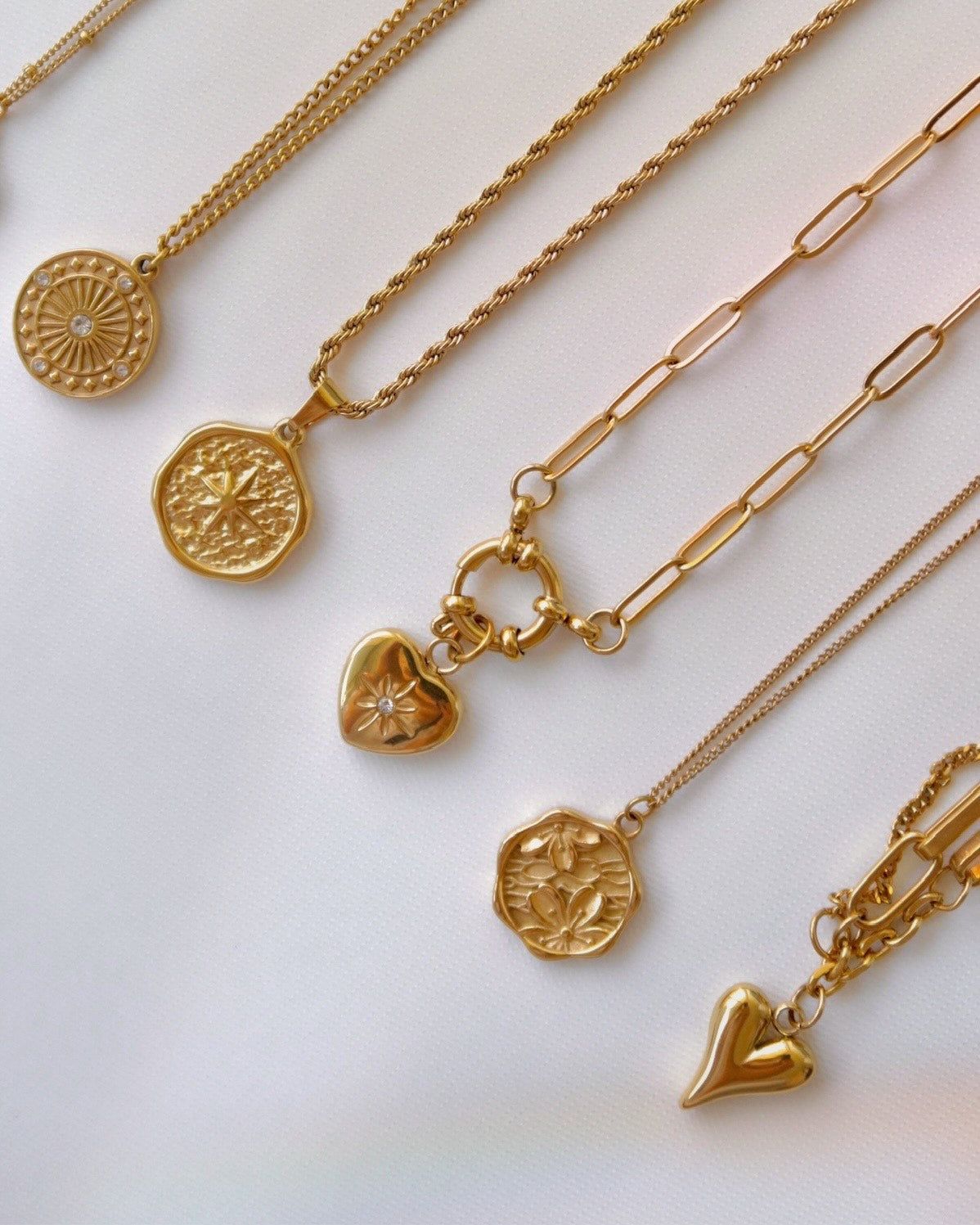
18k gold necklace
Most buyers assume every necklace is cast. It is not. Understanding this helps you read quotes.
Machine-made chain (cable, curb, rope, box, Cuban, figaro). Wire is drawn from 18k alloy, formed into links on a chain machine, soldered or laser welded, then diamond-cut and polished. This is fast and consistent, so per-gram labor is low.
Hand-assembled or cast necklaces (pendants, Byzantine-style, link designs with a custom motif). A wax or resin model is 3D printed, invested in plaster, burned out, and filled with molten gold. After casting it is cleaned, filed, assembled and polished. Labor is much higher.
What this means for you: a plain solid 18k gold cable chain and a hand-finished cast pendant necklace can have the same gold weight and very different labor costs. When a quote lists only one price per gram for both, ask why.
18k gold necklace price: the formula we use
We tell every customer the same thing: do the math yourself before you trust anyone's quote.
Price = (Gold weight in grams × 0.75 × live gold price per gram) + processing loss + labor + stones/findings + packaging + shipping
Why 0.75? Because 18k is 18 parts gold out of 24, which is 75%.
Illustrative example (the gold price here is an assumed figure for explanation only; use today's live price):
- Necklace weight: 10g of finished 18k gold
- Assumed pure gold price: $130 per gram
- Gold content cost: 10 × 0.75 × $130 = $975
- Add processing loss and labor (varies by design, often quoted per gram for machine chain and per piece for handmade work)
- Add packaging and shipping
Two things quietly changed the final number:
- Weight tolerance. Finished weight can drift a little from the sample. Ask for the tolerance in writing, for example plus or minus a small percentage.
- Gold loss. Filing, polishing and casting create dust. Reputable factories recover it and either account for it transparently or build a fixed loss rate into the labor charge. Ask which method is used.
The reason quotes that look too good exist: a hollow chain uses far less gold than a solid one of the same look and size. Hollow can be a legitimate design choice for lightweight statement pieces, but it should be labeled hollow, and the price should reflect that.
Solid vs hollow vs plated: know what you are buying
| Type | Gold content | Durability | Typical use | Red flag |
|---|---|---|---|---|
| Solid 18k gold chain | Full-weight 750 gold throughout | Highest; can be repaired and resized | Everyday and hisirloom necklaces | None, if weight matches spec |
| Hollow 18k gold chain | 750 gold, but with an empty core | Lighter and more dent-prone | Bold fashion links at lower weight | Sold as "solid" |
| Gold-plated or vermeil | Thin gold layer over base metal or silver | Wears through | Costume jewelry | Stamped 18k with no explanation |
| Gold-filled | Thicker gold layer bonded to base | Better than plated, not solid | Budget lines | Described as "real 18k" |
Our own practice: when a client asks for a necklace in a bold, wide link, we give two quotes, solid and hollow, with the weight of each. Many clients choose the hollow version for comfort. The point is that the choice is theirs and it is written down.
Choosing the right chain style for your product line
Chain style affects strength, wholesale price, and return rates. These are the styles we are asked about most:
- Cable chain: classic and strong, the safest choice for pendants. Easy to repair.
- Rope chain: high sparkle from twisted links. Can kink if too thin.
- Box chain: square links, smooth drape, good for small pendants. A damaged link is hard to fix invisibly.
- Curb and Cuban chain: a favorite for men's necklaces. Solid versions are heavy, so check the weight before quoting.
- Figaro chain: alternating link pattern; popular in fashion collections.
- Paperclip and elongated link chain: trendy, and the hollow version is common.
- Snake chain: very smooth, but poor at recovering if bent.
Clasps matter more than people think. A lobster clasp is the standard for daily wear. A spring ring is lighter but fails more often on heavier pieces. Toggle clasps are decorative and need a sturdy bar. We recommend a safety tab or double clasp on anything over a certain weight.
Necklace length guide (so your size chart is right)
| Style | Length | Where it sits |
|---|---|---|
| Choker | 14 to 16 inches (35 to 40 cm) | Base of the neck |
| Princess | 17 to 19 inches (43 to 48 cm) | Collarbone |
| Matinee | 20 to 24 inches (50 to 60 cm) | Above the bust |
| Opera | 28 to 36 inches (70 to 90 cm) | Below the bust |
We also build in a 2 inch (5 cm) extender on request. It cuts size-related returns and costs very little in gold.
18k gold hallmarks and testing: how to verify purity
Purity is the part of this business where trust is earned, so we are explicit about it.
What the marks mean. 18K , 750 , and Au750 all indicate 75% gold. A stamp is a claim. It is not proof.
How purity is actually verified:
- XRF analysis. A non-destructive X-ray fluorescence scan reads the alloy composition. It is quick and good for batch checks.
- Fire assay (cupellation). The reference method. It is destructive, so it is done on a sample.
- Acid or electronic testers. Acceptable only as a fast screen.
- Weight and size verification. A solid necklace has a weight consistent with its dimensions. If it feels too light, it is hollow or not gold.
Ask any 18k gold necklace manufacturer for: an XRF or assay report on the batch, the alloy recipe by color (yellow, white, rose), and the hallmark position on the piece. Request white gold alloy details too. Nickel-containing white gold can cause skin reactions and can trigger nickel-release rules in the EU, so many buyers prefer palladium-based white gold.
Your market rules matter. The US, the EU, the UK and Australia each have their own marking and labeling expectations, and the UK and some EU countries require independent hallmarking at an assay office for gold above set weights. Check your destination rules before you place a bulk order.
MOQ, sampling and lead time: what to expect
These terms vary by factory and by design, so treat the points below as the questions to ask, not fixed numbers.
- MOQ (minimum order quantity): Machine chains usually allow lower MOQs than custom cast designs, because tooling is not needed. Ask about MOQ per design and per color.
- Sampling: A paid sample is normal for gold. Ask whether the sample fee is credited against the bulk order.
- Lead time: Typically broken into CAD approval, sample, revision, bulk production, QC and shipping. Ask for the schedule per stage in writing.
- Revisions: Clarify how many sample revisions are included.
OEM vs ODM: which model fits your brand?
- OEM (original equipment manufacturing): You provide the design. We produce it to your specification and you own the design.
- ODM (original design manufacturing): We provide existing designs or modify our catalog styles with your branding.
Beginners often start with ODM to test the market, then move to OEM once a style sells. Both models are available through our OEM/ODM page .
A note on intellectual property. We work from your original designs, public-domain styles, or designs you can show you have the right to produce. A responsible factory will ask who owns the design, and a factory that does not ask is a risk to your business, because infringing goods can be seized at customs and can lead to legal claims against you as the importer.
A 12-point checklist to vet any 18k gold necklace manufacturer
Use this before you wire a deposit:
- Verify the address with a video call from the workshop floor.
- Business license and export registration.
- Written alloy spec for each gold color.
- Hallmark and stamp plan: what is stamped and where.
- XRF or assay report for a sample from your batch.
- Weight tolerance in writing.
- Solid vs declared hollow on the quote.
- Gold loss policy stated clearly.
- Sample before bulk, and compare the sample's weight to the quote.
- Packaging and insurance: insured shipping with tracking.
- Payment terms: be cautious about 100% upfront payment to unknown suppliers.
- After-sales: policy for defects, resizing and repairs.
If a supplier cannot answer five or more of these, keep looking.
Mistakes we see buyers make
1. Comparing price per piece instead of price per gram. Two necklaces can look the same and differ by 40% in gold weight.
2. Ignoring the clasp. The clasp is the first thing to fail. Ask for its wire thickness and spring tension.
3. Skipping a sample on repeat orders. A change in the chain machine settings can change link size. A pre-shipment check is cheap.
4. Not specifying the finish. High polish, satin and diamond-cut look different and wear differently. Put the finish in the purchase order.
5. Forgetting the destination market's requirements. Marking, nickel and import documentation can stop a shipment.
6. Treating the stamp as proof. Test it.
How we work at ZELI (our process in practice)
We have produced fine gold and diamond jewelry in Shenzhen since 2008, and our necklaces are made in 18k yellow, white and rose gold. Here is how an order normally runs:
- Brief: you send a sketch, photo, or CAD file, plus the target length, width, weight range and gold color.
- Quote: we replied with the estimated gold weight, the formula above, and the labor charge.
- CAD and approval: for custom pieces we show a render before any gold is used.
- Sample: we make a sample, weigh it, and send photos and measurements.
- Test: the sample goes through XRF testing and we share the result.
- Bulk production: with in-process checks at casting, assembly and polish.
- Final QC and hallmarking.
- Insured shipping with tracking.
Frequently asked questions
What is the best 18k gold necklace manufacturer?
The best one is the one that can prove purity with testing, quote transparently by gold weight, and show samples that match the bulk order. Location matters less than documentation.
Is 18k gold necklace manufacturer pricing the same as retail?
No. Factory pricing separates gold value from labor, so you pay for metal weight plus work. Retail prices add brand, overhead and margin.
What does 750 mean on a gold necklace?
It means 750 parts gold per 1,000, which is 75% pure gold, equal to 18k.
How can I tell if a necklace is solid 18k gold?
Check for the 750 or 18K stamp, compare weight to dimensions, and request an XRF or assay report. A magnet test alone is not reliable.
Is 18k gold good for daily wear?
Yes. It is harder than 24k and holds its color well, with a richer look than 14k. Very thin chains still need careful handling.
Can I order a custom 18k gold necklace in small quantities?
Often yes, especially for machine-made chains, but MOQ depends on the design. Ask for the MOQ per style and color.
What is the difference between solid and hollow gold chain?
Solid chain is gold throughout and is repairable. Hollow chain has an empty core, weighs less and costs less, but it dents more easily.
Which gold color is best for sensitive skin?
Yellow and rose 18k are usually well tolerated. For white gold, ask for palladium-based alloy instead of nickel.
How long does it take to manufacture an 18k gold necklace?
It depends on whether tooling or CAD is needed. Ask for a stage-by-stage schedule in writing.
Do you ship internationally?
Yes. Use insured, tracked shipping and confirm import duty and marking rules for your country first.
Ready to request a quote?
Send us your design, target length, width and gold color through our contact page , and we will reply with the estimated gold weight and a line-by-line price. You can also use our necklace size guide , diamond guide and 18k gold necklaces collection to prepare. For related reading, see our 18K gold ring cost guide , our 18K gold markings guide , and our guide to caring for 18K gold jewelry .
Conclusion: choose an 18k gold necklace manufacturer you can verify
The right 18k gold necklace manufacturer is the one that lets you check its work: a stated alloy, a quote built on gold weight, a tested sample and clear terms. Everything else, from chain style to finish, can be adjusted once those four are in place.
Before you place a bulk order, do these five things:
- Calculate the gold content yourself with weight × 0.75 × the live gold price.
- Confirm in writing whether the chain is solid or hollow.
- Ask for an XRF or fire assay report on a sample from your own batch.
- Agree the weight tolerance, gold loss policy, MOQ and lead time per stage.
- Order a sample, weigh it, and compare it with the quote before you commit to volume.
We built our process at ZELI around those checks because they protect both sides: you receive the gold you paid for, and we receive repeat orders instead of disputes. If you are comparing suppliers for a custom 18k gold necklace, solid 18k gold chain wholesale, or an OEM/ODM collection, send us your brief and we will answer with numbers you can verify.